


A girl member of « root and shoot group » planting a seedling after training
Protecting and ensuring long term survival of plant and animal species are among the millennium objectives and the essential actions to maintain life on earth. To achieve this, it is mandatory to reforest wherever trees are exterminated. The forest itself has a regenerative capacity if it is not invaded by destructors and climate change. All species of animals contribute in one way or another to this process of forest renewal. For example, gorillas and chimpanzees in the Kahuzi-Bièga National Park (PNKB) contribute to the restoration and maintenance of several plant species, especially those whose fruits are consumed by them. How do gorillas and chimpanzees produce seedlings that regenerate the forest? The Lwiro population animation campaign organized by the Primate Expertise association in collaboration with the Lwiro Primate Reception Center, still known as the Lwiro Primate Rehabilitation Center (CRPL), has attempted to respond to this question.

Dr. Augustin Kanyunyi Basabose in the midst of the children and their supervisors with seedlings during the environmental awareness session.
How do Gorillas and Chimpanzees produce seedlings?
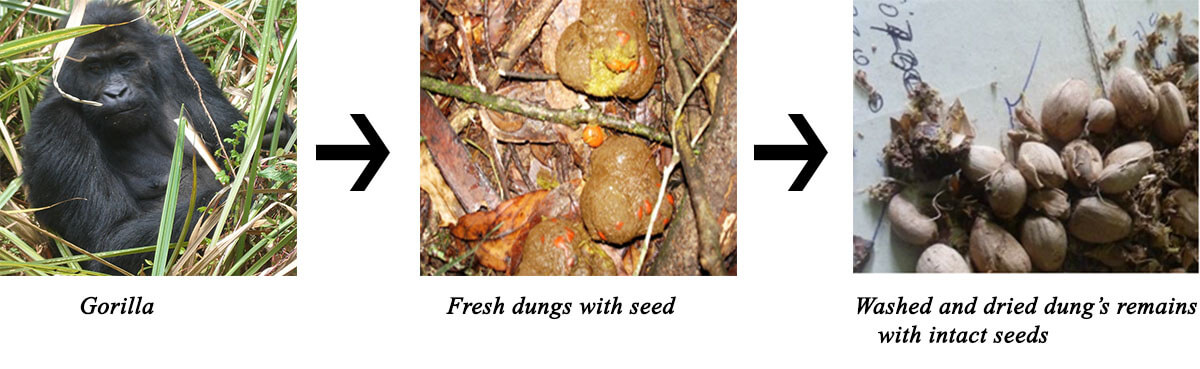
Several scientific papers related to the diet, self-medication of gorillas and chimpanzees of the Kahuzi-Bièga National Park were prepared and published by Yamagiwa et al., 1993, 1996, 2003 Basabose, 2002, 2004; Yamagiwa and Basabose, 2005, 2006, 2009; Kamungu et al., 2015, 2016. This research has shown that the diet of gorillas and chimpanzees consists essentially of plants. Gorillas are more folivorous and consume little fruit; While chimpanzees are more frugivorous. Once consumed, these fruits are digested in the digestive tract and release the often intact seeds through the faeces. This process allows the emergence of dormancy for certain seeds that germinate with difficulty. When they have fallen into a good soil, these seeds germinate easily and give new plants. In this way, gorillas and chimpanzees contribute to the propagation of plant species and the restoration of forests.
For the implementation of this project, PEX had received a small grant from a German organization, Bergorilla. This funding enabled us to hire qualified staff to monitor seed germination and seedling growth, organize a local awareness campaign on this issue and distribute seedlings produced experimentally.
The aim of this project is to restore a well-reforested tempo zone around the Kahuzi-Biega National Park (PNKB) with the seedlings produced experimentally and similar to the plant species encountered in the park in order to reduce the conflicting contacts between the riparian population and the Biodiversity, primates in particular.
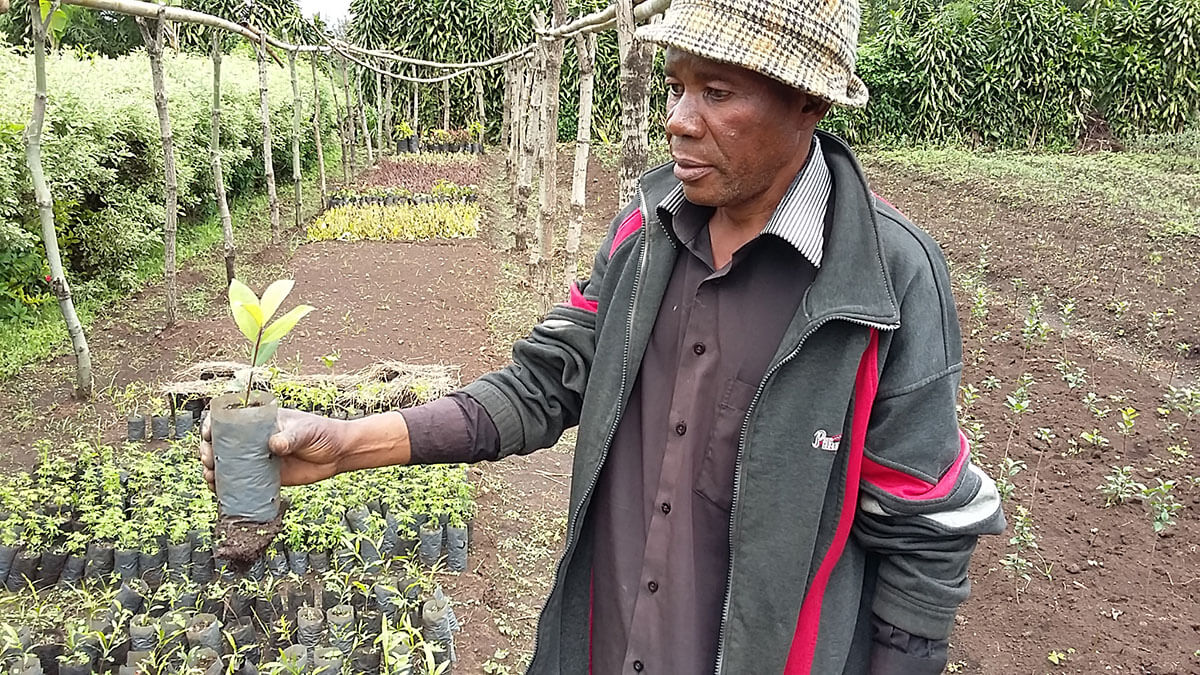
Nursery with plants from seeds found intact in monkey dung.
Teaching children about » the production of plants by the gorilla and chimpanzee » and distribution of seedlings

The campaign was held at CRSN / Lwiro in the CRPL premises on February 19, 2017. It was led by Professor Dr. Augustin Kanyunyi Basabose, an eminent researcher in Primatology Laboratory of the CRSN / Lwiro. The target population consisted generally of children (3 to 12 years old) enrolled at the environmental school in Lwiro.
A total of at least 150 children enrolled at the environmental school in Lwiro, led by their supervisor, was welcomed to the CRPL by the PEx and CRPL delegates. The children were arranged on lines and sang songs that conveyed a very important message: the need to protect the environment and the primates of Lwiro in particular. One of these songs « Tuunge mkono kituo CRPL ku protect ngila na sokomutu » means « Support the CRPL in the protection of gorillas and chimpanzees ». The children were applauded for their educational songs. Then, the speaker of the day, Professor Augustin K. Basabose was introduced to the children by their framer.
Under the attentive ear of listeners, for about 60 minutes Professor Augustin Basabose explained the process described above the process by which the gorilla and the chimpanzee produce the seedlings that grow to regenerate the forests.
The speaker showed that it was therefore possible to use animals, especially gorillas and chimpanzees, to restore the forests of the PNKB and the entire world.
This implies the protection of these animals and the plants in general against the various threats if we want to continue to enjoy the interests of this biodiversity.
In addition, supported by agricultural engineers Obula and Christian Masunga, the speaker explained the process of transplanting seedlings produced by gorillas and chimpanzees.
Some lessons were drawn by the speaker’s guided children: « To destroy trees is to precipitate the peril of animals and humans; Killing animals in the forest decreases the number and leads to the disappearance of these; Which negatively affects the regeneration of trees and biodiversity in general « . Hence, in terms of recommendation, you should:
- Protect animals especially gorillas and chimpanzees that give us new plants from the seeds picked up in their droppings;
- Make others aware of the need to protect gorillas and chimpanzees in addition to other animals, plant trees and especially those preferred by these animals;
- Each tree should be planted starting from the house before continuing the project into the vicinity of the parks;
- Denounce to the environmental police (ICCN in particular) any case of poaching or untimely cutting of the trees surprised in flagrance.
Transplanting prepared seedlings
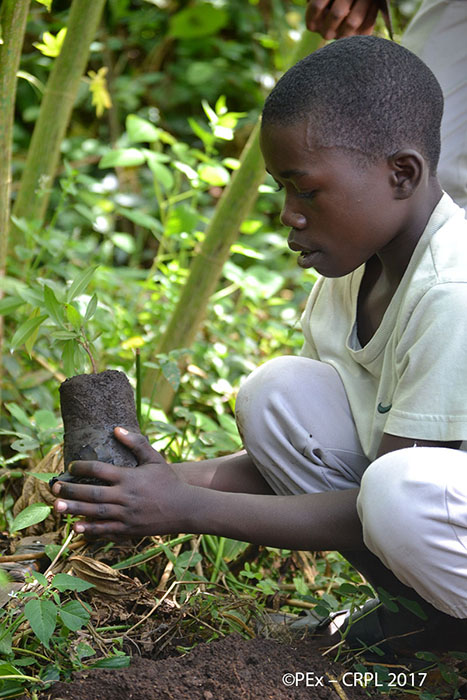
The children, their supervisors and other participants were built on the processes and then moved to the seedling transplanting site, a place currently set up to house other monkeys, given their growing number.
Conclusion
Before the closing of the session a word of thanks was sent by the moral authority of the CRPL to the organizers of this event and to all the participants especially the school children of the environmental school of Lwiro. Professor Basabose also thanked the children for their courage and potential involvement in advocating for the protection and conservation of Primates and their environment. He then thanked the designers of this environmental school and the children’s supervisors within it.
The ceremony was full of enthusiasm and the children understood the need to protect and conserve these very important animals (gorillas and chimpanzees) and their environment. They promised to put into practice all the recommendations given to them during this session.
[maxtitle type= »5″]THE EVENT IN IMAGE
[/maxtitle]
[g-slider gid= »5942″ width= »100″ height= »50″ random= »0″ watermark= »0″]