

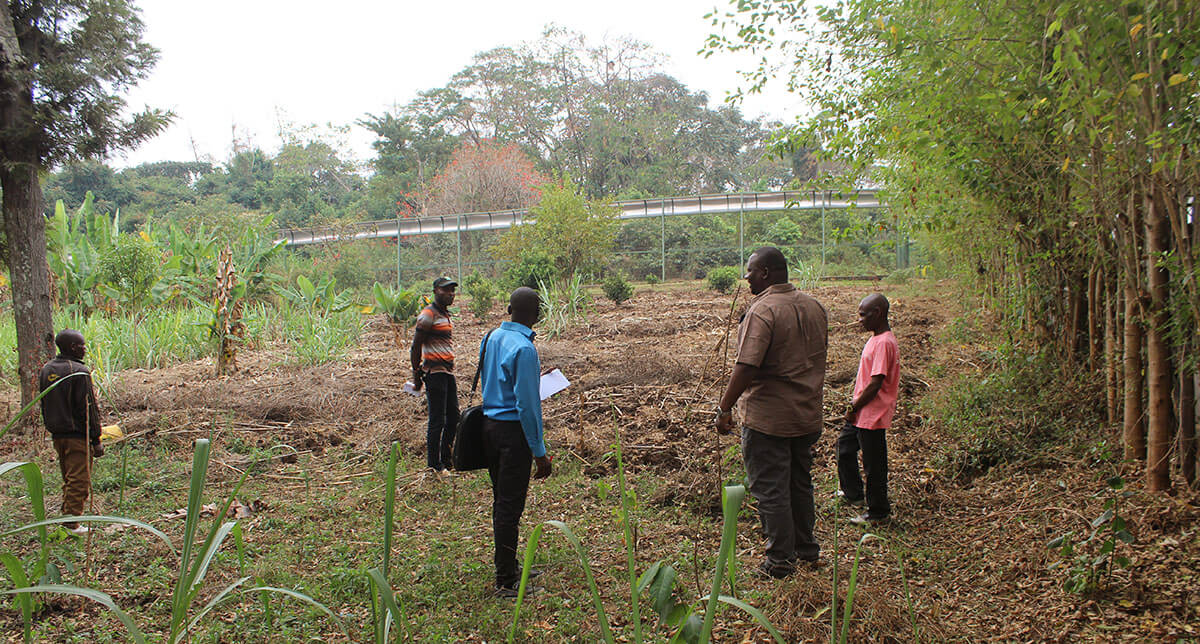
Pex’s researchers in full evaluation
In the year 2017, on the 12th day of August, Primate Expertise (PEx) conducted a guided visit to the Lwiro Primate Rehabilitation Center (CRPL), evaluating the growth of seedlings produced By the seeds found in the droppings of gorillas and chimpanzees.
Indeed, in February 2017, PEx launched a campaign for the voluntary distribution of seedlings to the population and local institutions concerned with contributing to the rehabilitation of the living environments of animals and primates in particular, green spaces in schools , Universities, local research centers, etc. These seedlings are the result of an experimental experiment conducted by PEx from the intact seeds harvested from the fecal matter of gorillas and sympatric chimpanzees in the forest of Kahuzi-Biega National Park. The CRPL and the University of the Fiftieth Anniversary of Lwiro were among the first beneficiaries of the results of this experimental project which PEx intends to pursue on a large scale to meet the needs of the people living near the park who support this unique approach.
The CRPL is home to many captive animals including primates (chimpanzees and many other species of small monkeys), which are confiscated from the hands of poachers by the Congolese Institute for Nature Conservation (ICCN). The question of the reintroduction of these animals into forested areas is still difficult, as they require a lot of material and human resources that the CRPL does not yet have, and these animals are likely to linger for some time in the center. Unfortunately, the number of these animals continues to grow due to two main reasons:
a. The ever increasing magnitude of anthropogenic pressures on primates in the forest. There are still reports of some poachers still holding chimpanzee babies and other small monkeys;
b. The fact that the contraceptive method to limit the reproduction of chimpanzees has not yet been fully successful. Indeed, although rare, a few cases of births have been reported to the center recently.
In light of the above, it is predicted that in future years, the CRPL would have difficulty controlling these animals in the sanctuary and responding adequately to their food, medical and recreational needs. Therefore, it is necessary to prepare the land and, if necessary, to reforest large areas of forest by using the local species prized by these animals. It is in view of all this that the CRPL is interested in the results of the project « plants great apes » supervised by PEx.
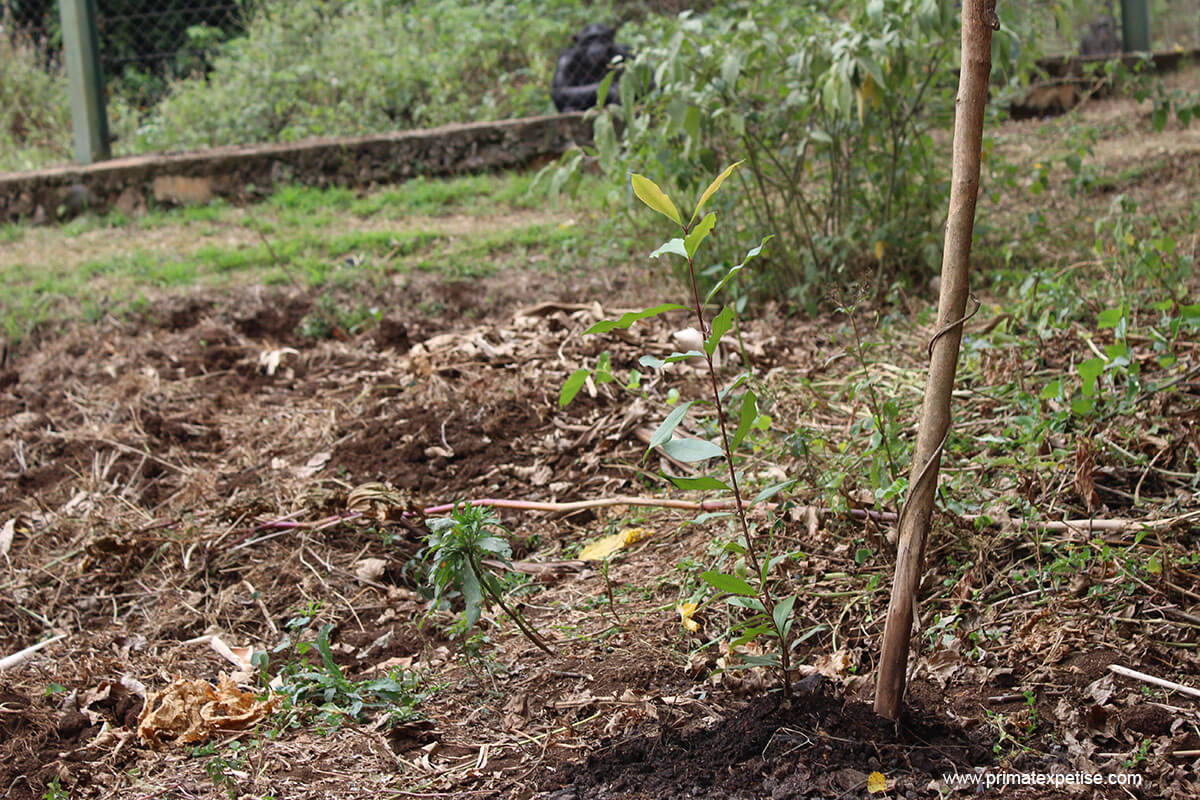
A seedling of Syzygium parvifolium planted in the CRPL enclosure with an adult male chimpanzee in the background
A total of 51 seedlings were transplanted as a trial by the CRPL. These seedlings belong to 5 species: Ekerbergia capens (5 individuals), Allophylus kivuensis (6 individuals), Syzygium parviffolium (25 individuals), Bridelia bridelifolia (11 individuals), Newtonia buchananii (4 individuals). They were planted on a plot of 500m2.
During the visit, we found that all transplanted seedlings normally grow. The figures below show the images of some growing seedlings. This gives a good impression on the evolution of the growth and the adaptation of the seedlings obtained from the seeds found in the droppings of gorillas and chimpanzees.

Seedling of Bridelia bridelifolia in good health despite a long dry season.
Finally, with the support of international, national and local partners, PEx continues to disseminate the results of this project, with a view to restoring degraded natural forest habitats. The demand for seedlings from the droppings of the great apes is accentuated overnight in the community living around the Kahuzi-Biega National Park.
[maxtitle type= »5″]LA VISITE EN IMAGE
[/maxtitle]
[g-slider gid= »5934″ width= »100″ height= »50″ random= »0″ watermark= »0″]