
The socio-economic development of pygmy indigenous peoples living around protected areas is one of the factors contributing to the sustainable conservation of non-human primates, including Grauer’s gorillas. Anthropogenic pressure on park resources are due to unemployment. Income generating activities may improve livelihood of pygmies and reduce the pressure on wildlife.
Thanks to substantial financial support from Wild Earth Allies (WEA) , Primate Expertise (PEx) is carrying out a pilot project entitled « small-scale breeding of guinea pigs to improve pygmy community livelihood« .
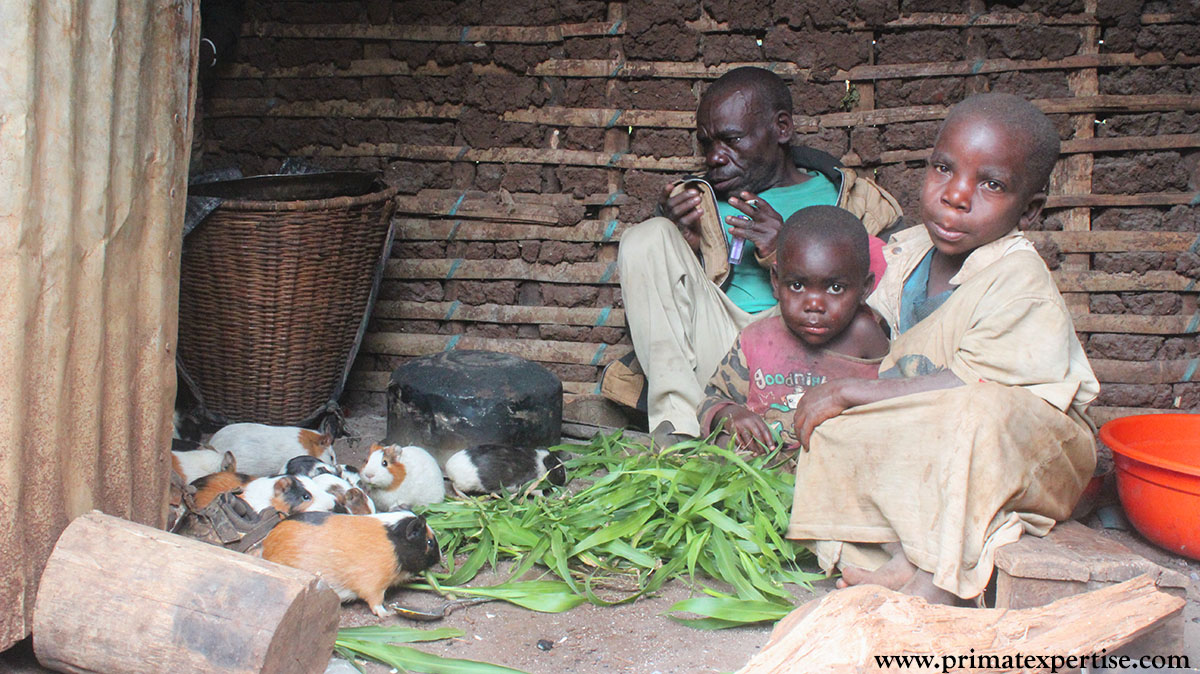
The objectives of this project is in two-fold: provide meat to pygmy household and family farming. In the first part, the following specific objectives are pursued:
• Increase livestock production to increase the income of Pygmy households;
• Encourage the marketing of domestic animals, particularly guinea pigs, to support the Pygmy household;
• Ensure social cohesion with other communities through guinea pig breeding and agriculture; etc.
The following approaches have been used and some mid-term results of the project are palpable:
• Distribution of guinea pigs in households: This activity is continued by the project in five different target villages. Sixty-five percent (65%) of affected households are already affected.
• Mobilization and training of the heads of beneficiary households: apart from mobilization and collective training, a woman leader is taken in each village, equipped and trained. She is involved in weekly monitoring of the evolution of guinea pigs in households and providing technical advice to household managers. A local veterinarian conducts regular visits to beneficiary households.
• guinea pig breeding thrives in pygmy households: after the delivery of the animals, several cases of female birthing are already recorded in some households. This is the example of the household of Mr. Cokozi Kembe resident of the village of Buyungule who received a number of 6 guinea pigs in February including a male and 5 women. After 6 months, he already has 17 heads in his household. According to an interview with him, these guinea pigs are currently his wealth, make him forget the best of their lost paradise namely: the forest, currently the Kahuzi-Biega National Park. Today, they also earn him some social recognition in the community.
• Guinea pig, a revolving product to improve pygmy community livelihood: The multiplication center of the broodstock feeds the community guinea pig husbandry of pygmy villages. These breeding houses were built by Primate Expertise to serve the households of the village and are managed by the Pygmy village chief in collaboration with the woman leader. A consensus was reached with the beneficiaries that, upon reaching a certain number of guinea pigs in the household (10 heads minimum) after a given time, one to two guinea pigs are returned to the guinea pig by the recipient. This approach, already implemented, allows the sustainability of the project.